LAB #3 - TRUST


At the heart of social capital is trust.

Communities, towns, states, and countries that are rich in social capital have high levels of trust. Trust makes the world go round, and specifically it is necessary for economic, political, and social systems to function. At the heart of any healthy community is a high amount of trust. In 1970, 75% of Americans trusted each other. Today, only 30% of Americans say people can be trusted. Does it matter?

Some observers worry that with declining trust in America today it will be hard to work together to solve the vast societal problems we face.


Do you think that most people trust each other?

Take a camera, sketch pad, notebook, tape recorder, or video camera into your community to investigate trust. Here are some ideas, but you can approach this in many different ways. You could interview people, survey them about their level of trust, set up an experiment where you “drop” a dollar, scarf, notebook, or something valuable on the floor in a library and see if people return it to you (this might get expensive), or ask people at the mall if you can borrow their cell phone to call home. Do something within your own comfort level. If approaching strangers in a mall is scary, try something else. Whatever you do, try something creative to investigate trust in your community and report your results.

LAB #4 - WORK

It's been said that Americans live to work. And it's true that, compared to much of the world, we Americans do work a lot. But sometimes our long work hours can get in the way of other good things like family and community. Here's what a typical US workday looks like:

Here's a minute by minute breakdown of a typical American workday. 
Activity                         Average time spent

Working*                                             9:12

Sleeping                                               7:39

Leisure                                                 2:52

Eating                                                  2:07

Cooking, cleaning, etc                         :52

     Grooming                                             :48      

Caring for children, elderly, etc           :34

Shopping                                              :33

Other                                                    :09

Volunteering                                         :07

Education                                             :06

      Talking to people on the phone           :05      

Obviously, for the average American, there's not a lot of time for family or community. Here's where you come in. Interview someone about how they spend their typical workday. Write down the number of minutes they spend on each of the activities listed above. Then hack their life and reschedule their typical work day in order to increase connections with family and community. Share a comparison of your interviewee's before and after workdays and your thoughts about the impact of work on you and your community.

*remember, school counts as working for students. 

LAB #5 - CIVIC ENGAGEMENT

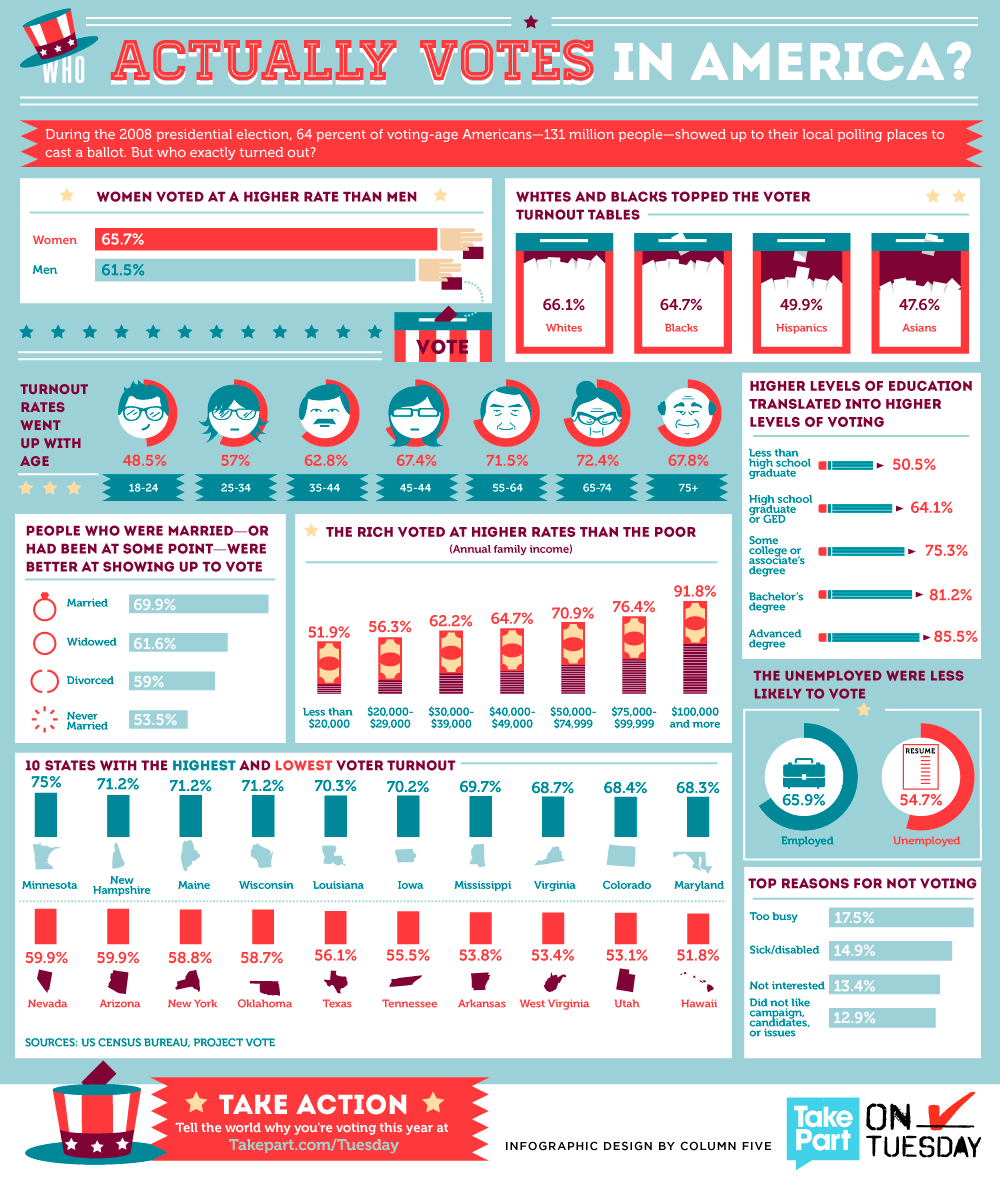
Over the past half century, civic and political involvement has declined precipitously. Voting, political party membership, community organizing, attending public meetings, and almost every other indicator of political participation are at all time lows.


As you can see, most people are not very involved in the civic life of their community. Document yourself doing one or more of the civic listed above: write a letter to your congressperson, attend a school board meeting, attend an organized protest (try not to break any laws or get arrested). Make a post reflecting upon the impact of your civic action on you and your community.

LAB #6 - VOTING


The importance we place on voting says a lot about how much we value our shared community. 


Americans aren't the world's best voters, but how much do individuals value the sacred right to vote that people fought and died for? Let's find out. Get a few pieces of poster board, a big magic marker, some people (they often can be found at the mall, Wal-Mart, or Mickey Ds) and poll at least ten citizens on the following question: How much would you sell your permanent right to vote for? Do not pay them! Photograph the vote sellers holding a poster with the monetary amount they think their vote is worth and then record them explaining their statement. Share their photographs and your thoughts about how much Americans value democracy. 

*Alternate lab
Contact your local board of elections, set up a voter registration drive in your community, and document your results.

LAB #7 - HOME

Over the last fifty years, while the size of the average American house has more than doubled, the number of people living in the average home has actually fallen from 3.67 in 1948 to 2.55, today. (Check out this great animation of expanding home size.) The most recent statistics from the National Association of Home Builders show that the average American home grew from 983 square feet in 1950 to 2,434 square feet in 2005. Furthermore, in 1950, only one percent of homes built had four bedrooms or more, but by 2003, 39 percent of new homes had at least four bedrooms. Garages have become almost obligatory, with only eight percent of new homes built without a garage, as opposed to 53 percent built without one in 1950. 

 
Think about your own home. How many people live in it? How many bedrooms does it have? How big is it? Does it have a garage (or two)? And most of all, does it connect or separate you from the community? 


There's actually some cities that have designed building codes to increase community. In Celebration, Florida, for example, all new houses must be built with a front porch. Some towns ban garages, in other communities, all new developments must be built with sidewalks.
Go out and walk your neighborhood, interviewing neighbors, surveying the houses, apartments, and condominiums, and thinking about how your neighborhood impacts community. Document the aspects of your neighborhood (buildings, sidewalks, gardens, parks, playground, streets) that increase and those that decrease community. Draw a map of your home and your neighborhood with three tangible changes (like adding sidewalks, playgrounds, or reducing traffic speed) that would make your neighborhood more community oriented. In your post, reflect on the impact of the way we live on community connectivity.

LAB #8 - IDENTITY


Who are you? Not just your name. Who are you? Maybe when you identify yourself you think first of your race, or gender, or your age, or religion, or even what part of the country you come from, or maybe, before all else, you consider your socio-economic status (wealth) to be the most central core of your identity. 

Maybe you've never really thought about this before. So what are you? American? Middle Class? Hispanic? Asian? Straight? Teenager? Christian? Likely, it's a bundle of all those things. One way you can think about your identity is by considering what kinds of people you spend most of your time with. Are they all the same race as you? Are they always of the same age group as you? Or are you that rare kind of person who surrounds themselves with people of many different backgrounds? So think for a moment about who you are.

Even when we build strong communities, it is often with people who are a whole lot like us (same race, ethnicity, socio-economic standing, age, and background). Making connections with people like us is called bonding social capital, and it's good. But when we connect, engage, and learn from people different from us, it's called bridging social capital, and it's even better


So lets think about identity, and let's build some bridges. Interview a person different from you (the difference could be in age, ability/disability, race, socioeconomic status, sexual orientation, religion, country of origin). Your interview should be at least 5 minutes long. Ask this person who is different from you any questions you wish but be sure to ask some questions about the ways in which you are different. Then let them interview you and ask you questions. Record your interview (in writing, audio*, video, photographs) and post it along with your thoughts and insights on identity, differences, similarities, and community. 

*Voice Record Pro is a free app for audio recordings.

LAB #9 - FOOD


Americans like to eat. Who doesn't? In many cultures, food is the glue that holds community together. Unfortunately, since 1973, there's been over a 1/3 decline in the frequency of families eating together. And more and more, instead of slow food eaten at church picnics, neighborhood barbecues, or around the family table, we often find ourselves eating fast food all alone.


Your community's kitchens and dinning rooms are your laboratory. Go eat, observe, research, investigate, and document the eating habits of your community. Share your observations, videos, photographs, or words and reflections on how food connects or separates your community. In the past, students have compared and contrasted fast food and slow food, documented the difference between local and industrial food establishments, and have even hosted slow food dinners to investigate community.